What is Tinting Strength?
Tinting strength of pigment
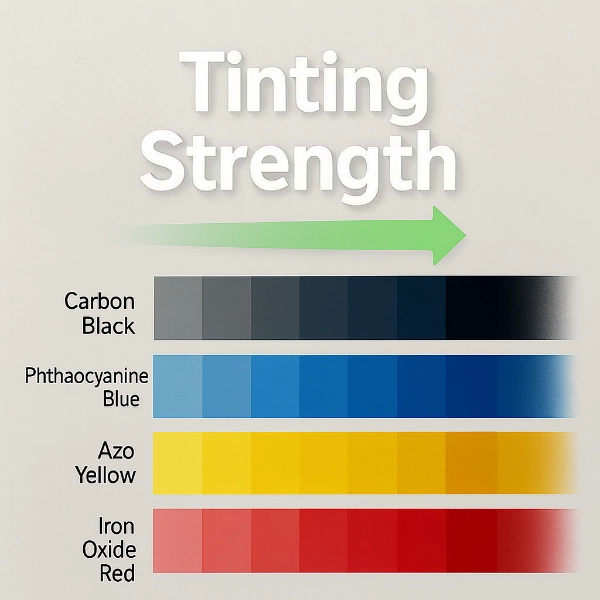
Tinting strength refers to the color intensity exhibited by a unit mass of a colored pigment when mixed with a white pigment, typically titanium dioxide (TiO₂) quantified by comparison with a standard reference sample.
This property is a key measure of how strongly a chromatic pigment can influence the final shade in mixtures with titanium dioxide (TiO₂).
How to measure tinting strength?
Measurement methods generally fall into two categories: visual comparison and instrumental colorimetry.
- Visual comparison relies on trained human judgment to assess color differences between a sample and a reference blend.
- Instrumental colorimetry employs spectrophotometers or colorimeters to capture objective reflectance and color data.
Together, these methods provide either a rapid qualitative check or a precise, standardized quantitative evaluation, depending on the level of accuracy required.
Tinting strength of titanium dioxide
Strictly speaking, the phrase “tinting strength of titanium dioxide” is not a standard term in pigment science. For white pigments such as titanium dioxide, the correct optical performance indicators are reducing power (the ability to lighten mixtures through scattering) and hiding power (the ability to cover substrates).
Together, reducing power and hiding power form part of the optical performance evaluation of titanium dioxide.
Tinting strength of carbon black
Similar to titanium dioxide, the leading white pigment worldwide, carbon black is the dominant black pigment, widely used in paints, rubber (tires), inks, coatings, and plastics.
The tinting strength of carbon black is defined as its blackening capacity when blended with a standard white pigment, typically titanium dioxide (TiO₂). A higher tinting strength value indicates a deeper, more intense black shade in the mixture. In practice, tinting strength is measured through reflectance ratios between the sample and a reference carbon black paste.
The tinting strength is expressed as T = (S/I) × 100, where T is the tinting strength percentage, and S and I are the reflectance readings of the sample and the reference carbon black, respectively. A higher T value indicates stronger tinting strength, meaning the carbon black produces a deeper black shade when mixed with a white pigment.
Tinting strength of paint
In paint formulations, tinting strength describes how effectively a pigment alters the depth and character of a color when combined with a white base such as titanium dioxide (TiO₂).
It is commonly evaluated by mixing a colored pigment with a standard white paint containing TiO₂, followed by measuring the color intensity or reflectance of the mixture. A high tinting strength means that a small amount of pigment can significantly alter the color, whereas a low tinting strength requires a larger amount of pigment to achieve the same effect.
Importance in the Paint Industry
- Color matching and consistency: Ensures manufacturers can maintain uniform shades across different batches.
- Cost efficiency: High tinting strength pigments require less dosage, improving economic performance.
- Applications: In architectural coatings, automotive paints, industrial coatings, and printing inks, tinting strength is a critical quality parameter.