
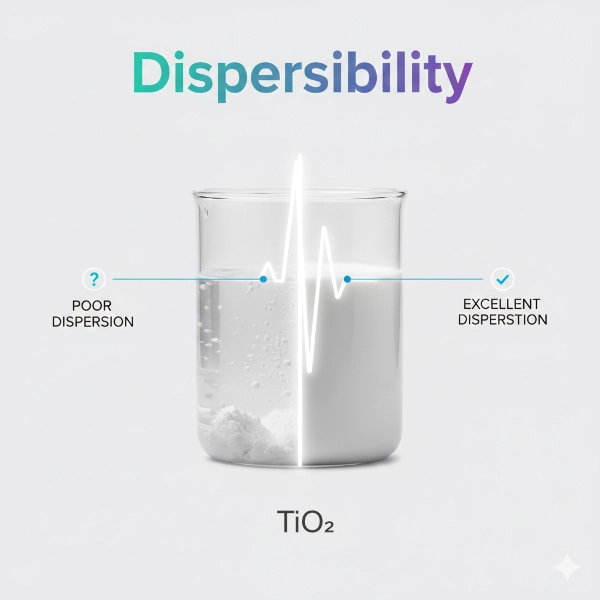
What is Dispersibility?
Key Factors Influencing TiO2 Dispersibility
Dispersibility is not an isolated property but the result of a complex interplay between the pigment’s physical characteristics and its chemical environment. Several critical factors determine how effectively titanium dioxide particles transition from a dry powder to a stable dispersion. Understanding these factors—ranging from the precision of surface treatment to the control of particle size distribution—is essential for optimizing production efficiency and achieving the desired optical performance in final applications.
Surface Treatment (Inorganic and Organic Coating)
The surface chemistry of Titanium Dioxide particles is the most decisive factor for its dispersibility. Raw TiO₂ particles naturally tend to stick together due to high surface energy. To overcome this, premium grades like CR-706 undergo a specialized multi-stage treatment:
-
Inorganic Coating: Layers of Zirconia and Alumina are precipitated onto the particle surface. This creates a physical barrier that prevents flocculation and adjusts the surface charge, significantly improving the aqueous dispersibility and long-term stability in coatings.
-
Organic Treatment: A final layer of organic polyols is often added to reduce surface tension. This makes the pigment much easier to wet when first added to the resin, shortening the time required in a high-speed disperser to reach the desired fineness of grind.
Particle Size Control and Distribution
While a small mean particle size (typically around 0.27 μm) is essential for maximum light scattering, the distribution of those sizes is equally important for excellent dispersibility:
-
Narrow Distribution: If a grade has a wide range of sizes, the very small particles (“fines”) can fill the gaps between larger ones, forming dense, hard-to-break agglomerates.
-
Efficiency: Our advanced milling process ensures a narrow particle size distribution. This means less energy is required during the dispersion protocol to separate the particles, ensuring a smooth, grit-free finish with a consistent Hegman gauge reading of ≤25 μm.
Compatibility with Dispersion Media
The final factor is how the pigment interacts with your specific dispersion medium, whether it is water-borne or solvent-borne:
-
Pigment Loading: The concentration of titanium dioxide powder in the slurry affects the shear force generated. An optimal loading ensures that the mechanical energy from the high-speed impeller is effectively transferred to the agglomerates.
-
Resin Interaction: The type of resin and the presence of dispersants also play a role. A well-treated TiO2 surface ensures that once particles are separated, they remain stable and do not re-clump (re-agglomerate) during storage.
Role of Dispersibility in Industrial Applications
Coatings and Paints
In both water-borne and solvent-borne systems, superior dispersion ensures maximum opacity (hiding power) and high gloss. It prevents surface defects like “seeds” or grit, resulting in a smooth, professional finish.
Plastics and Masterbatches
For plastic manufacturers, a high dispersibility index means consistent color strength and prevents the clogging of filter screens in extrusion equipment. It also improves the UV resistance of the final plastic part by ensuring a uniform protective layer of TiO₂.
Printing Inks
In high-speed printing, fine particle dispersion is crucial for ink flow and prevents plate plugging, ensuring sharp images and vibrant colors.
Dispersion & Fineness of Grind
Hegman Gauge Test (Fineness of Grind)
This is the most common field test. After high-speed dispersion, the slurry is spread on a Hegman gauge. We look for the point where particles become visible. A result of ≤25 μm (or 6.5+ Hegman units) indicates professional-grade dispersion.
Tinting Strength Method (ISO 8781-1)
By comparing the color intensity of a dispersed sample against a standard, we can calculate the dispersibility index. If the tinting strength develops quickly with minimal energy, the pigment is considered highly dispersible.
Particle Size Analysis
Using laser diffraction, we monitor the mean particle size and distribution to ensure the agglomerates have been successfully broken down into primary particles (approx. 0.27 μm).