Introduction
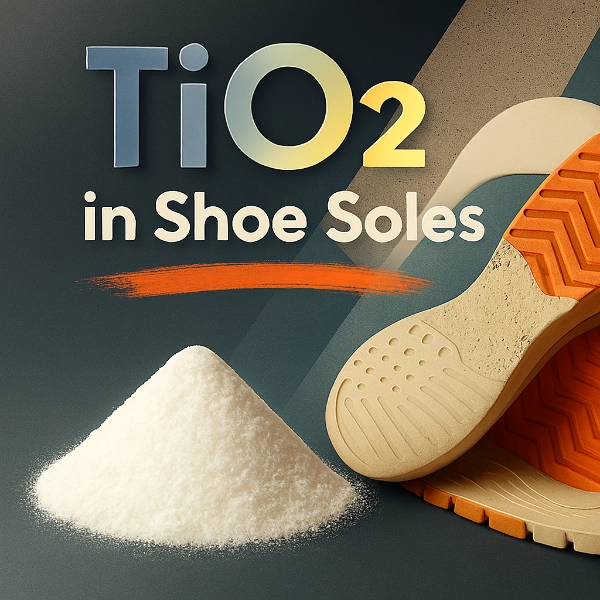
Titanium dioxide (TiO₂) is widely recognized in materials science for its ability to deliver bright whiteness, strong opacity, and resistance to UV‑induced aging. Beyond coatings, plastics, and rubber, it has also become a valued additive in footwear materials.
In the footwear industry, TiO2 contributes not only to appearance but also to performance. It ensures soles remain clean and consistent in color, helps prevent yellowing under sunlight, and supports durability in everyday wear.
Shoe Sole Basics
Different Types of Soles
In terms of layered structure and functional roles, a shoe sole can be divided into three main components: the outsole, the midsole, and the insole (footbed).
Types of Sole Materials
-
Rubber – Known for durability, slip resistance, and flexibility. It is widely used in athletic and work shoes where traction and wear resistance are critical.In these rubber outsoles, titanium dioxide primarily delivers excellent whiteness and opacity, while also acting as a minor reinforcing filler that can improve tensile strength and other mechanical properties. In rutile grade, TiO2 offers excellent UV resistance, helping extend the service life of rubber soles.
-
EVA (Ethylene Vinyl Acetate) – Lightweight and cushioning, EVA foams dominate midsoles in running and casual footwear. While they deliver comfort, their porous structure makes them prone to discoloration and uneven pigment distribution.Titanium dioxide (TiO₂) not only blocks UV light to prevent yellowing but also improves pigment dispersion, ensuring a cleaner and more uniform appearance.
-
PU (Polyurethane) – Resilient and long‑lasting, PU midsoles provide strong shock absorption and support, making them popular in comfort and performance shoes. Light‑colored PU soles are prone to yellowing under heat and UV exposure.Titanium dioxide (TiO₂), especially in rutile grade, helps stabilize color, block UV radiation, and extend durability. While not a primary reinforcing filler, TiO2 also contributes to maintaining mechanical integrity by reducing degradation from light aging.
-
TPR (Thermoplastic Rubber) – A cost‑efficient option that combines flexibility with ease of molding, often used in casual and children’s footwear.In these soles, titanium dioxide (TiO₂) functions primarily as a white pigment, delivering brightness and opacity while improving dispersion to ensure a uniform appearance. It also helps maintain color stability against friction and light exposure, and rutile‑grade TiO₂ provides added UV protection, slowing down aging in a material that is otherwise less weather‑resistant than PU.
Across sole materials such as rubber, EVA, PU, and TPR, titanium dioxide consistently supports product quality by delivering whiteness and opacity, stabilizing color against yellowing, enhancing UV resistance, and improving pigment dispersion for a uniform appearance. In addition, rutile‑grade TiO2 helps extend durability by slowing down photo‑aging, ensuring that footwear maintains both performance and aesthetics over time.