
2026 Guide: How to Choose the Right Titanium Dioxide Supplier for Coatings
In the coatings industry, product performance is directly influenced by the quality of raw materials used in formulation. Among these, titanium dioxide (TiO₂) stands out as the most critical pigment due to its ability to provide opacity, brightness, and long-term durability. Whether used in architectural coatings, industrial paints, or automotive finishes, TiO₂ plays a key role in defining the final product quality.
In the coatings industry, product performance is directly influenced by the quality of raw materials used in formulation. Among these, titanium dioxide (TiO₂) stands out as the most critical pigment due to its ability to provide opacity, brightness, and long-term durability. Whether used in architectural coatings, industrial paints, or automotive finishes, TiO₂ plays a key role in defining the final product quality.
In the coatings industry, product performance is directly influenced by the quality of raw materials used in formulation. Among these, titanium dioxide (TiO₂) stands out as the most critical pigment due to its ability to provide opacity, brightness, and long-term durability. Whether used in architectural coatings, industrial paints, or automotive finishes, TiO₂ plays a key role in defining the final product quality.
However, choosing the right titanium dioxide supplier is not a simple procurement decision. Variations in product quality, particle size distribution, surface treatment, and manufacturing consistency can significantly affect coating performance. A poor supplier choice can result in issues such as reduced hiding power, poor dispersion, inconsistent finish, and increased production costs.
For B2B buyers, including coatings manufacturers, distributors, and importers, supplier selection must be based on a structured evaluation process. Factors such as product quality, technical support, pricing stability, and supply reliability all contribute to long-term success.
As the coatings market becomes more competitive in 2026, buyers are shifting from price-based decisions to value-driven sourcing strategies. This guide will help you understand exactly how to evaluate and choose the right titanium dioxide supplier for your business.
Quick Answer
The right titanium dioxide supplier for coatings is one that delivers consistent quality, application-specific grades, stable supply capacity, competitive pricing, and technical support to optimize coating performance.
Key Takeaways
- TiO₂ quality directly impacts coating performance
- Rutile grades are preferred for durability and outdoor use
- Supplier consistency is more important than lowest price
- Surface treatment technology affects dispersion and stability
- Reliable logistics ensure uninterrupted production
- Technical support improves formulation efficiency
- Long-term partnerships reduce sourcing risks
Why Titanium Dioxide Supplier Selection is Critical
Titanium dioxide accounts for a significant portion of coating formulations often representing 20 to 30% of total raw material cost. More importantly, it is responsible for critical performance characteristics.
In coatings, TiO₂ performs several essential functions:
- Enhances hiding power, reducing the number of coats required
- Improves whiteness and color retention
- Provides UV resistance, preventing degradation
- Increases weather durability for exterior applications
- Improves surface smoothness and finish quality
Because coatings are often exposed to environmental conditions such as sunlight, moisture, and pollutants, the quality of TiO₂ used can significantly impact long-term performance.
Understanding Titanium Dioxide Types Before Buying
Before evaluating suppliers, you must understand the two main types of TiO₂ used in coatings.
Rutile Titanium Dioxide (Industry Standard Choice)
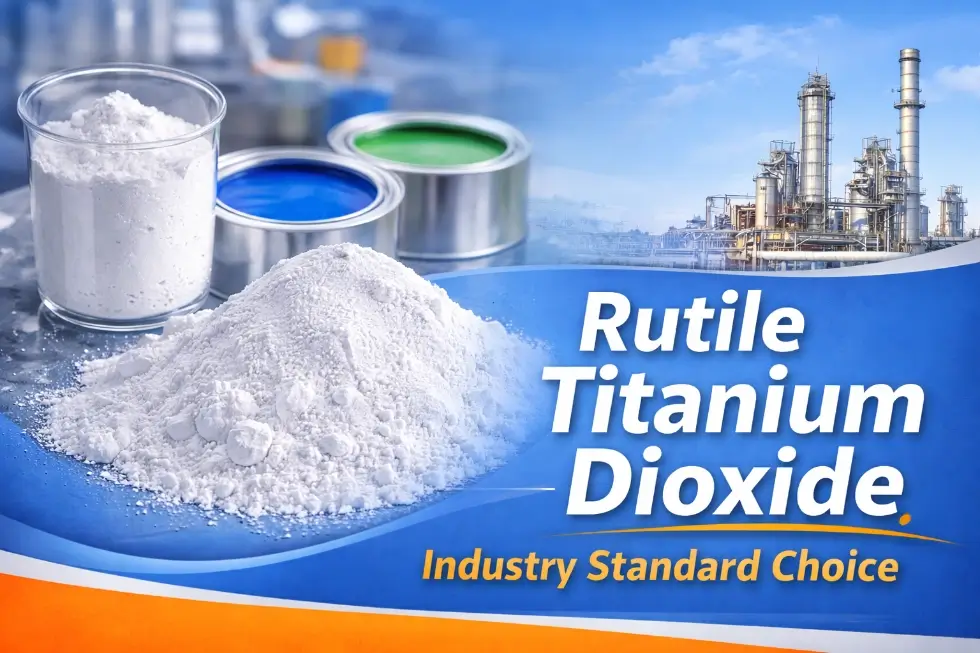
Rutile TiO₂ is the most commonly used grade in coatings due to its superior performance characteristics. It offers excellent weather resistance, high opacity, and better UV protection.
It is widely used in:
- Exterior architectural coatings
- Automotive paints
- Industrial coatings
Anatase Titanium Dioxide (Limited Applications)
Anatase TiO₂ is generally used in applications where cost is a primary concern and durability requirements are lower.
It is suitable for:
- Interior coatings
- Decorative paints
- Low-cost formulations
Key Technical Properties Every Buyer Must Evaluate
When comparing suppliers, understanding technical specifications is essential for making the right decision.
Purity LevelEnsure coating stability with high-purity TiO₂ standards.
Purity is one of the most important indicators of titanium pigment quality. A recommended standard for coatings applications is ≥98% TiO₂ content, which ensures consistent pigment performance and stability in formulations.
Higher purity levels contribute to improved brightness, better opacity, and reduced formulation variability. In contrast, lower purity materials may contain impurities that negatively affect coating quality and increase raw material consumption.
Lower purity often results in reduced hiding power and higher overall usage in coatings.
Particle Size DistributionOptimize light scattering for maximum opacity and coverage.
Particle size plays a critical role in determining how effectively titanium dioxide scatters light. The ideal particle size range for coatings is typically 0.2–0.3 microns, which provides optimal opacity and coverage.
Uniform particle size distribution ensures consistent dispersion within the coating system, leading to smoother finishes and improved visual appearance. Poor particle control can cause uneven coatings and reduced performance.
Inconsistent particle size leads to weak hiding power and poor surface finish.
Surface Treatment TechnologyEnhance durability and weather resistance with advanced inorganic coatings.
Surface treatment is a key factor that differentiates standard and high-performance titanium dioxide products. Advanced surface treatments enhance the compatibility of TiO₂ with coating formulations and improve overall performance.
Common surface treatments include:
- Aluminum Oxide (Al₂O₃)
- Zirconium & Aluminum (Zr-Al)
- Silicon Dioxide (SiO₂)
These treatments provide multiple benefits, including improved dispersion, enhanced weather resistance, and better interaction with resins and binders. This results in more stable and durable coatings.
Surface-treated titanium dioxide delivers superior performance in demanding coatings applications.
Refractive Index (Core Performance Factor)Unlock superior brightness and light-scattering efficiency.
Titanium dioxide has one of the highest refractive indices among white pigments, typically around 2.7, which is a key reason for its exceptional opacity and brightness.
This high refractive index allows TiO₂ to scatter light more efficiently than alternative pigments, making it highly effective in achieving strong coverage and color performance in coatings.
This property makes TiO₂ significantly more efficient than other white pigments in coatings formulations.
Production Processes: Chloride vs SulfateA strategic comparison of Chloride and Sulfate technologies in TiO₂ production.
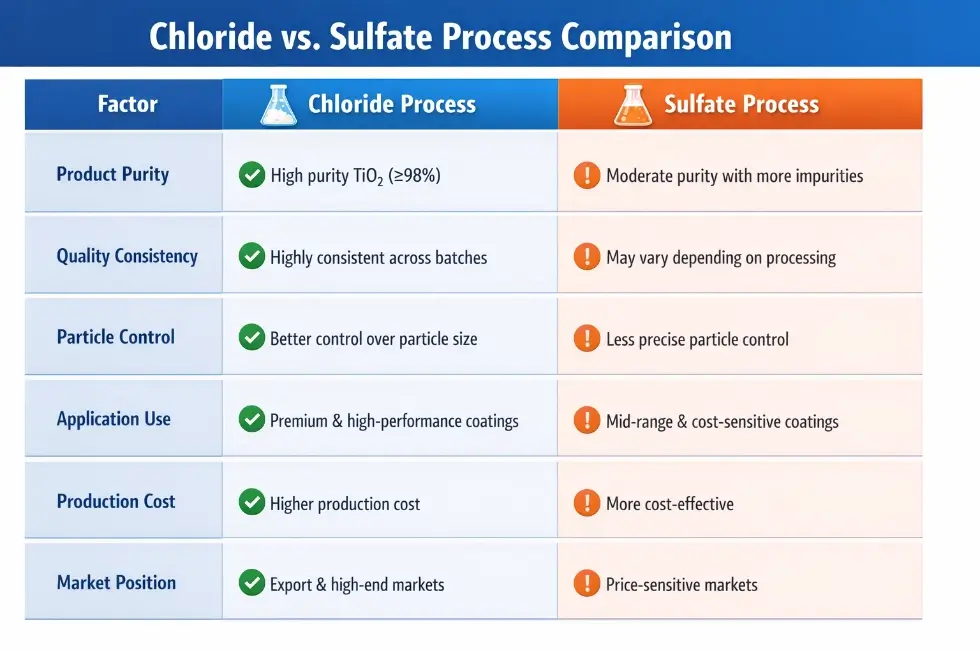
Understanding how titanium dioxide is produced helps you evaluate supplier quality and positioning.
| Factor | Chloride Process | Sulfate Process |
|---|---|---|
| Product Purity | High purity TiO₂ (≥98%) | Moderate purity with more impurities |
| Quality Consistency | Highly consistent across batches | May vary depending on processing |
| Particle Control | Better control over particle size | Less precise particle control |
| Application Use | Premium and high-performance coatings | Mid-range and cost-sensitive coatings |
| Production Cost | Higher production cost | More cost-effective |
| Market Position | Preferred for export and high-end markets | Common in price-sensitive markets |
To better understand production quality differences, read our detailed guide on
TiO2 manufacturing: chloride vs sulfate processes
Critical Performance Factors for Coatings BuyersEvaluate real-world metrics beyond basic technical specifications.
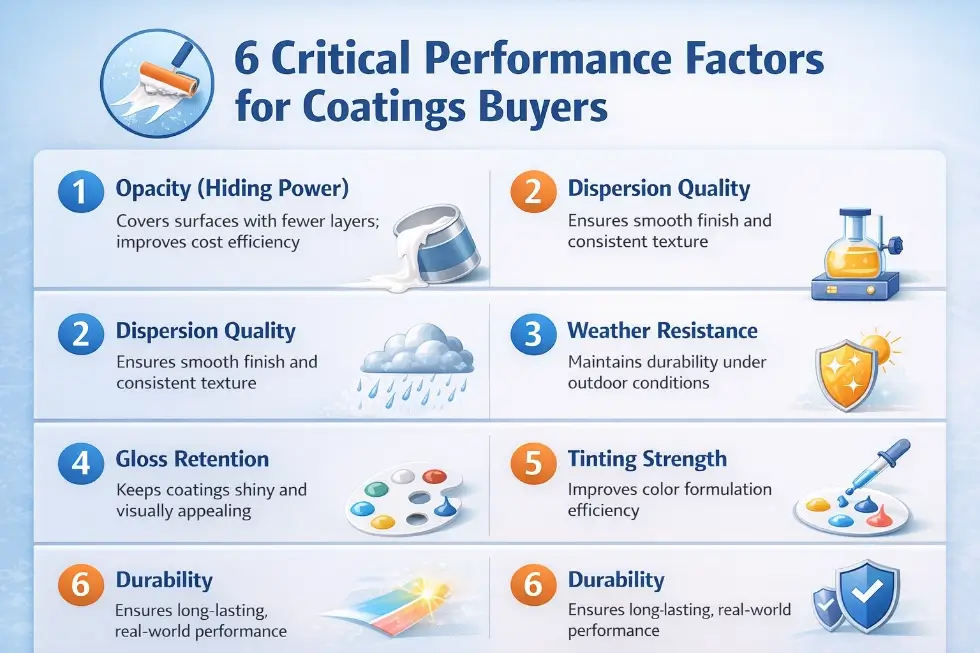
When selecting a titanium dioxide supplier, evaluating performance metrics is more important than reviewing basic specifications alone. These factors directly influence coating quality, efficiency, and long-term durability in real-world applications.
1: Opacity (Hiding Power)
Opacity determines how effectively a coating can cover a surface with minimal layers. High hiding power reduces material consumption and improves cost efficiency, especially in large-scale coatings production where raw material usage directly impacts profitability.
A supplier providing consistent opacity performance helps manufacturers achieve uniform coverage across batches. This ensures fewer application defects and better overall product quality, particularly in industrial and architectural coatings.
2: Dispersion Quality
Dispersion quality affects how uniformly titanium dioxide is distributed within the coating system. Proper dispersion ensures smooth application, consistent texture, and improved visual appearance in the final coating.
Poor dispersion can lead to issues such as streaking, agglomeration, or uneven surfaces. Working with suppliers that offer optimized dispersion characteristics helps improve formulation stability and reduces production challenges.
3: Weather Resistance
Weather resistance is essential for coatings exposed to outdoor environments. Titanium dioxide must withstand UV radiation, moisture, and environmental pollutants without degrading over time.
High-performance materials enhance coating durability by maintaining color stability and preventing surface breakdown. This is especially important for exterior coatings where long-term performance directly affects customer satisfaction.
4: Gloss Retention
Gloss retention refers to the coating’s ability to maintain its surface shine and aesthetic quality over time. This factor is particularly important for premium and decorative coatings where visual appeal is critical.
A supplier offering stable gloss retention properties ensures that coatings remain visually consistent even after prolonged exposure to environmental conditions. This helps maintain product value and reduces the need for frequent reapplication.
5: Tinting Strength
Tinting strength determines how effectively titanium dioxide interacts with color pigments within a formulation. Higher tinting strength allows better color development with lower pigment usage.
This improves formulation efficiency and reduces overall production costs. Suppliers with consistent tinting performance enable manufacturers to achieve precise color results with minimal variation.
6: Durability
Durability defines how well a coating performs under real-world conditions, including abrasion, chemical exposure, and environmental stress. Strong durability ensures that coatings maintain their protective and decorative functions over time.
High-durability coatings reduce maintenance requirements and extend product lifespan. For B2B buyers, this translates into better long-term value and improved customer satisfaction in end-use applications.
How to Identify a Reliable Titanium Dioxide Supplier?
Selecting the right supplier is essential for ensuring consistent coating performance, stable supply, and long-term business success. Reliable suppliers are typically defined by their technical capabilities, product range, and industry experience.
Common indicators of a professional supplier include:
- Multiple product grades for different coating applications
- Advanced production technology
- Strong R&D and technical support
- Complete documentation (TDS, MSDS, COA)
- Proven export experience
These capabilities provide several advantages, including consistent product quality, better formulation support, and reliable supply chain management. Suppliers with these strengths are better equipped to meet the demands of industrial coatings production.
A supplier with these capabilities is more likely to support long-term business growth and stable operations.
Supplier Evaluation Table
Use the following table to quickly compare and evaluate titanium dioxide suppliers based on key performance and business factors.
| Criteria | Low-Level Supplier | Professional Supplier | Premium Manufacturer |
|---|---|---|---|
| Product Quality | Low | Medium | High |
| Consistency | Unstable | Moderate | Excellent |
| Technical Support | None | Limited | Advanced |
| Application Range | Generic | Semi-specialized | Customized |
| Pricing Efficiency | Low | Medium | High |
Common Mistakes Buyers Must Avoid
Many buyers make the mistake of focusing primarily on price while ignoring overall product quality and performance. This approach often leads to inconsistent coating results, higher material consumption, and increased long-term costs.
Another common issue is neglecting technical evaluation. Factors such as purity level, particle size distribution, and surface treatment directly affect coating efficiency, yet they are often overlooked during supplier selection.
In addition, skipping sample testing and underestimating logistics reliability can create serious production challenges. Delays in supply or selecting an unsuitable TiO₂ grade can negatively impact both performance and delivery timelines.
Avoiding these mistakes helps ensure stable production, better coating quality, and long-term business success.
Step-by-Step Buying Guide Before Choosing the Titanium Dioxide Supplier
Selecting the right titanium dioxide supplier requires a structured approach. Instead of random sourcing, professional buyers follow a step-by-step process to reduce risk and improve performance.
Step 1: Define Application Requirements
The first step is to clearly identify the specific requirements of your coatings application.
- Interior or exterior coatings
- Water-based or solvent-based systems
- Required durability and performance level
A clear understanding of application requirements helps avoid selecting unsuitable material grades.
Step 2: Select the Appropriate Titanium Dioxide Type
Choosing the correct type of titanium dioxide is essential for achieving the desired performance.
- Rutile grades are typically used for high-performance and outdoor coatings due to their superior durability and UV resistance.
- Anatase grades are more suitable for cost-sensitive or indoor applications where performance requirements are lower.
Selecting the right type forms the foundation of an effective coating formulation.
Step 3: Shortlist Qualified Suppliers
Once requirements are defined, buyers should focus on
- Offer coatings-specific grades
- Have export experience
- Provide technical documentation
Avoid working with general traders who lack specialization in coatings applications.
Step 4: Request Samples for Testing
Before committing to bulk procurement, it is essential to request product samples and conduct performance testing.
Key Tests to Perform:
- Opacity and hiding power
- Dispersion performance
- Gloss and finish quality
Sample testing significantly reduces sourcing risks and ensures product compatibility.
Step 5: Evaluate Technical Documentation
A reliable supplier should provide complete and transparent documentation for all products. This typically includes
- TDS (Technical Data Sheet)
- MSDS (Material Safety Data Sheet)
- COA (Certificate of Analysis)
These documents allow buyers to verify product specifications, ensure compliance with industry standards, and maintain quality consistency.
Proper documentation confirms both product reliability and supplier credibility.
Step 6: Compare Cost with Performance Value
Price comparison alone is not sufficient when evaluating suppliers. Buyers should assess the overall cost-performance balance, including factors such as pigment efficiency, coverage, and durability.
Higher-quality titanium dioxide may have a higher upfront cost but often reduces total formulation costs due to better performance and lower consumption.
A value-based approach ensures better long-term cost efficiency.
Step 7: Verify Supply Chain Stability
Supply reliability is a critical factor for coatings manufacturers operating at scale. Buyers should evaluate the supplier’s production capacity, lead times, and logistics capabilities.
Suppliers with strong export experience and efficient supply chains are better positioned to ensure timely delivery and minimize operational disruptions.
A stable supply chain supports continuous production and business growth.
Step 8: Start with a Trial Order
Before establishing a long-term agreement, it is advisable to place a small trial order. This allows buyers to test the product under real production conditions and evaluate supplier performance.
Trial orders provide valuable insights into consistency, delivery reliability, and overall service quality.
This step helps validate supplier suitability before large-scale commitment.
Step 9: Build Long-Term Supplier Partnerships
Once a supplier has been validated, the focus should shift toward building a long-term partnership. This includes negotiating better pricing, securing stable supply agreements, and establishing ongoing technical collaboration.
Strong supplier relationships contribute to improved efficiency, cost control, and product innovation over time.
Long-term partnerships create a foundation for sustainable business growth.
Future Market Trends in Titanium Dioxide Supply
The titanium dioxide market is evolving rapidly, driven by increasing demand for high-performance coatings and stricter environmental standards. Buyers are now focusing on suppliers who can deliver consistent quality while meeting global compliance requirements.
Key trends shaping the industry include:
- Shift Toward High-Performance Grades: Demand is increasing for advanced TiO₂ pigments that offer better opacity, durability, and efficiency in coatings applications.
- Focus on Sustainable Production: Environmental regulations are pushing manufacturers to adopt cleaner production processes and reduce emissions.
- Adoption of Advanced Manufacturing Technologies: Modern production methods, especially chloride-based processes, are improving product consistency and overall performance.
- Growing Importance of Supply Chain Reliability: Buyers now prioritize suppliers who can ensure stable delivery, strong export capability, and minimal disruption.
- Increased Role of Technical Support and Innovation: Suppliers investing in R&D and application support are better positioned to meet evolving customer requirements.
Proper alignment with these trends helps buyers improve product quality, reduce risk, and build a more competitive coatings business.
Final Thoughts
Selecting the right titanium dioxide supplier is a strategic decision that affects product quality, cost efficiency, and market success. B2B buyers can improve both product quality and profitability.
At Nanyang Hengxiang Chemical Products Co.,Ltd., we focus on delivering application-specific titanium dioxide solutions designed for the coatings industry.
With advanced production processes, strict quality control, and dedicated technical support, we help businesses achieve better efficiency and stable results.
Explore our product range and connect with our team to find the right solution for your coatings applications.