Rutile vs. Anatase Titanium Dioxide: Which One Should You Choose
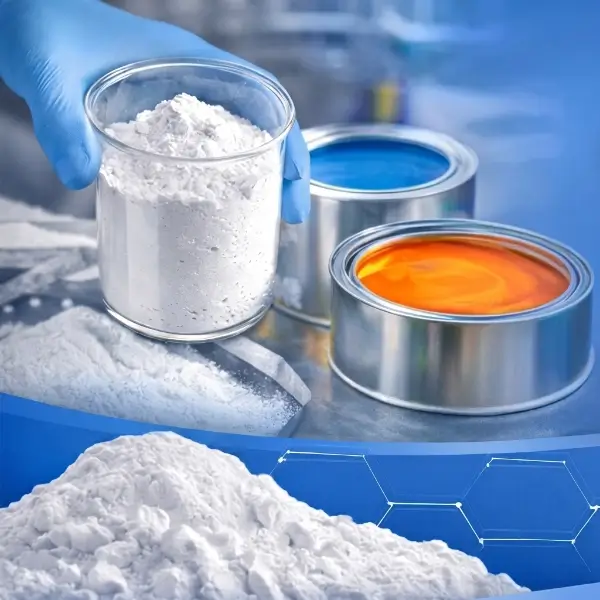
Titanium dioxide (TiO₂) is one of the most widely used industrial pigments in global manufacturing because of its strong whiteness, high opacity, excellent brightness, and chemical stability. It is commonly used in industries such as coatings, plastics, paper, rubber, inks, cosmetics, and construction materials where product appearance, durability, and performance directly affect market competitiveness.
For industrial manufacturers and B2B buyers, selecting the right titanium dioxide grade is an important decision because not all TiO₂ performs the same way. Rutile titanium dioxide and anatase titanium dioxide are the two most commonly used forms, and each has a different crystal structure. These structural differences directly impact important properties such as UV resistance, weather durability, hiding power, heat stability, and production efficiency.
A coatings manufacturer producing exterior paints may require stronger UV resistance and long-term durability, and a paper manufacturer may prioritize higher brightness and lower raw material costs. Choosing the wrong grade can result in poor product performance, faster degradation, higher pigment consumption, and increased manufacturing expenses.
This is why understanding the difference between rutile titanium dioxide and anatase titanium dioxide is critical before making a purchasing decision. This guide explains their technical differences, industrial applications, and how buyers can choose the right option based on specific manufacturing requirements.
Quick Answer
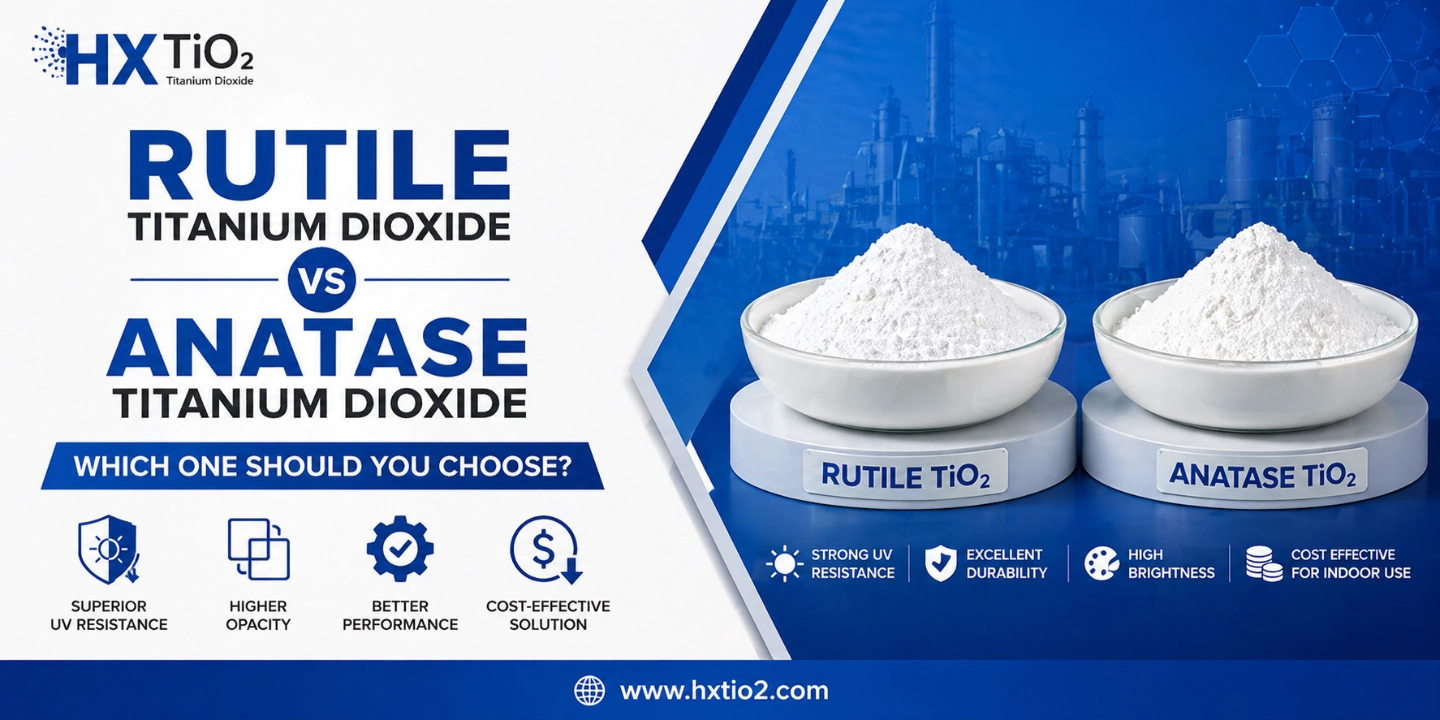
Rutile titanium dioxide is better for most industrial applications because its 2.7 refractive index, stronger UV resistance, better weather durability, and higher opacity make it ideal for coatings, plastics, and other high-performance manufacturing applications.
Key Takeaways
- Rutile has a higher refractive index than anatase
- Optimal particle size is usually 0.2–0.3 microns
- Rutile offers better UV and weather resistance
- Anatase is more cost-effective for indoor applications
- Rutile provides stronger chemical durability
- Application requirements should drive purchasing decisions
What is Rutile Titanium Dioxide?
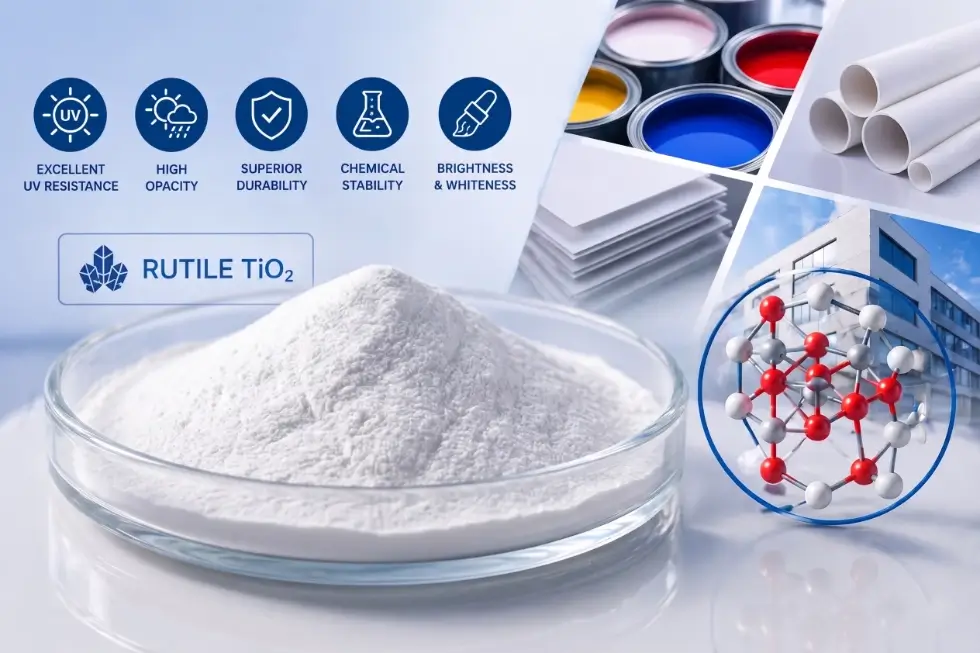
Rutile titanium dioxide is the most commonly used TiO₂ grade in industrial applications because of its higher refractive index of approximately 2.7, which allows it to scatter light more efficiently than anatase. This results in stronger opacity, better whiteness, and improved overall performance in demanding industrial formulations.
It is widely preferred in applications where long-term durability and high performance are critical.
Key Characteristics of Rutile Titanium Dioxide
- High opacity
- Strong whiteness
- Excellent UV resistance
- Better weather durability
- Strong chemical stability
- Long-term performance efficiency
Production Process of Rutile Titanium Dioxide
Rutile titanium dioxide is commonly produced through the chloride process and sulfate process, and both methods directly affect purity levels, particle size control, and final product performance. Buyers should understand these production methods because they often influence both pricing and application suitability.
The chloride process is the benchmark for premium rutile grades. It ensures a base crystal purity of ≥ 99% by utilizing gaseous distillation to remove trace metal impurities (such as iron and vanadium). This process provides superior particle size control, resulting in better brightness and a cleaner blue undertone. These grades are the preferred choice for high-end coatings, automotive paints, and engineering plastics where maximum durability and consistency are required.
The sulfate process is generally more cost effective and offers wider market availability. It is often used for buyers looking for a balance between product performance and lower production costs.
Buyers can better understand how different manufacturing methods impact product purity and performance by reviewing the titanium dioxide production process.
What is Anatase Titanium Dioxide?
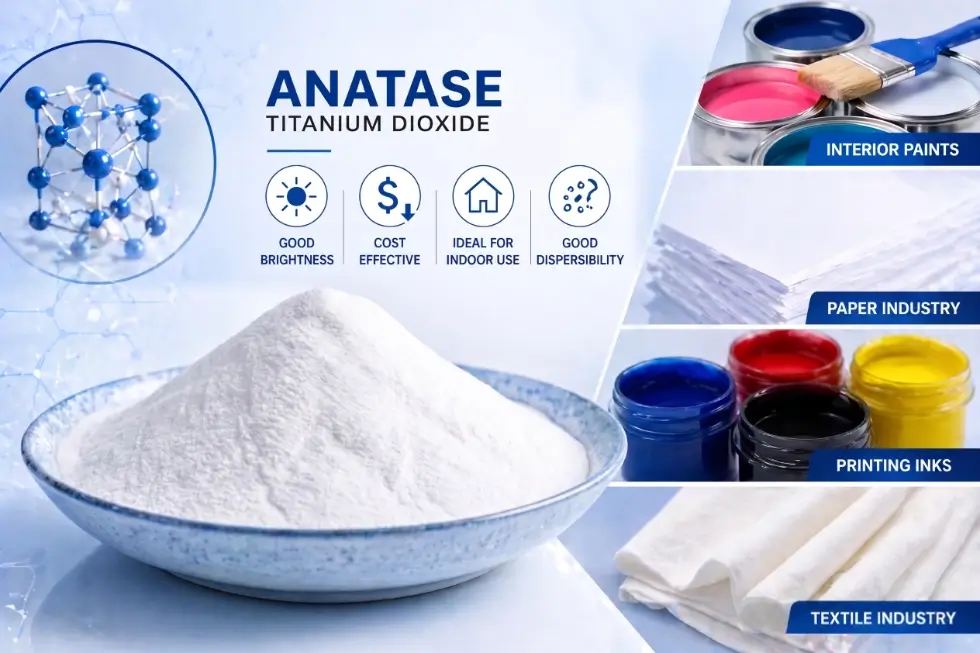
Anatase titanium dioxide is another crystal form of TiO₂ that typically has a lower refractive index of approximately 2.5, which results in lower opacity compared to rutile grades. It is usually selected for cost-sensitive applications where premium durability is not required.
Anatase performs well in controlled indoor environments with limited UV exposure.
Key Characteristics of Anatase Titanium Dioxide
- Lower production cost
- Good brightness
- Lower UV resistance
- Lower weather durability
- Suitable for indoor applications
- Cost-effective for basic formulations
Production Process of Anatase Titanium Dioxide
Anatase titanium dioxide is primarily produced through the sulfate process, which is widely used because of its lower production cost and broad commercial availability. This process plays an important role in determining product pricing, purity levels, and application suitability.
Sulfate-produced anatase typically offers moderate purity levels, good brightness performance, and cost efficiency for manufacturers focused on budget-sensitive production. It is commonly used in industries such as paper, printing inks, interior paints, textiles, and other applications where high UV resistance and long term outdoor durability are not required.
Rutile vs Anatase Titanium Dioxide: Key Differences
Understanding the technical differences between rutile and anatase helps industrial buyers select the right TiO₂ grade based on performance requirements, durability expectations, and long-term production efficiency.
| Comparison Factor | Rutile Titanium Dioxide | Anatase Titanium Dioxide |
|---|---|---|
| Refractive Index | Approximately 2.7 | Approximately 2.5 |
| Particle Size | 0.2–0.3 μm | 0.2–0.4 μm |
| TiO₂ Content | 92% – 95% | ≥98% |
| UV Absorption | Higher | Lower |
| Heat Stability | ≥ 300°C (Excellent) | ≥ 200°C (Good) |
| Oil Absorption | 14–20 g/100g | 18–26 g/100g |
Refractive Index Comparison
Refractive index determines how efficiently titanium dioxide scatters light. Rutile titanium dioxide has a refractive index of approximately 2.7, and anatase has a refractive index of approximately 2.5.
This makes rutile more effective for:
- Higher opacity
- Better whiteness
- Stronger brightness
- Improved hiding power
Anatase provides lower light scattering efficiency and is commonly used in applications where premium opacity is not required.
Particle Size Comparison
Particle size directly affects opacity and dispersion performance. Rutile titanium dioxide typically has a particle size range of 0.2 to 0.3 μm, and anatase usually ranges from 0.2 to 0.4 μm.
Better particle size control helps manufacturers:
- Improve dispersion
- Increase opacity efficiency
- Reduce agglomeration
- Improve formulation consistency
Poor particle distribution can reduce final product performance.
Purity Level Comparison: Understanding TiO₂ Content
In the titanium dioxide industry, “purity” is more than just a percentage—it is a strategic balance between the base crystal and functional surface treatments. Understanding these levels helps industrial buyers evaluate product consistency and manufacturing efficiency.
Finished Product TiO₂ Content
For finished pigments, the TiO₂ percentage varies based on the specific application and the density of the surface coating.
| Grade Category | Typical TiO₂ Content | Primary Focus |
|---|---|---|
| Premium Rutile (Chloride) | 92% – 95% | High weather resistance & UV protection |
| Standard Rutile (Sulfate) | 94% – 98% | Versatility & cost-performance balance |
| Anatase Grades | ≥98% | High whiteness & indoor cost-efficiency |
The Role of Purity in Performance
It is a common misconception that a higher percentage of TiO₂ always equals better quality. For high-performance Rutile, a content of 93% is often superior to 98%. This is because the “missing” percentage consists of advanced inorganic coatings (such as Alumina, Silica, or Zirconia) that are essential for long-term durability.
However, the quality of the foundation—the Base Crystal Purity—is critical. Our chloride process ensures a base purity of ≥ 99% before coating, which directly improves:
- Product consistency: Ensuring stable performance across different production batches.
- Whiteness & Undertone: Minimizing trace metal impurities (like iron) for a cleaner, bluer phase.
- Performance stability: Providing a reliable base for uniform surface encapsulation.
- Manufacturing efficiency: Optimizing dispersion and reducing resin consumption for downstream formulators.
UV Absorption Comparison
UV resistance is important for products exposed to sunlight and outdoor environments. Rutile offers significantly higher UV absorption compared to anatase.
Rutile titanium dioxide is commonly used in:
- Exterior coatings
- Construction materials
- Automotive paints
- Outdoor plastics
Its UV stability helps prevent:
- Yellowing
- Cracking
- Surface degradation
- Reduced lifespan
Anatase performs better in indoor applications with limited sunlight exposure.
Heat Stability Comparison
Heat stability is a critical factor in high-temperature manufacturing processes, particularly in plastics and powder coatings. It measures the pigment’s ability to maintain its color and brightness without yellowing when exposed to thermal stress.
Generally, Rutile titanium dioxide offers superior thermal stability, remaining stable at temperatures ≥ 300°C. In contrast, Anatase titanium dioxide is typically recommended for processes where temperatures do not exceed 200°C, as it is more prone to color shifts at elevated heat levels.
Higher heat stability supports:
- Plastic processing
- Rubber manufacturing
- Industrial coatings
- High temperature formulations
Rutile performs better in heat intensive industrial applications.
Oil Absorption Comparison
Oil absorption affects pigment loading and formulation costs. Rutile titanium dioxide generally has oil absorption levels of 14 to 20 g/100g, and anatase typically ranges from 18 to 26 g/100g.
Lower oil absorption helps manufacturers:
- Improve formulation efficiency
- Reduce raw material usage
- Lower production costs
- Improve processing performance
Higher oil absorption may increase formulation costs over time.
Best Industrial Applications for Rutile and Anatase Titanium Dioxide
Industrial buyers usually select titanium dioxide based on technical requirements such as opacity performance, UV resistance, heat stability, chemical durability, and production cost. Although rutile offers better overall performance because of its higher refractive index of 2.7, anatase remains suitable for industries that prioritize lower manufacturing costs and indoor applications.
Understanding where each grade performs best helps manufacturers improve formulation efficiency and avoid selecting the wrong material for specific applications.
Best Applications for Rutile Titanium Dioxide
Rutile titanium dioxide is commonly used in industries that require higher durability, stronger opacity, and better environmental resistance. Its 98%+ purity, stronger UV absorption, and heat stability up make it ideal for demanding industrial applications.
Coatings Industry
Titanium dioxide remains one of the most widely used pigments in industrial coatings because of its strong opacity and UV resistance in coating applications.
The coatings industry requires strong hiding power, weather durability, and UV resistance. Rutile titanium dioxide is widely used because its higher refractive index improves opacity and helps coatings maintain long term performance in outdoor environments.
Common applications include:
- Exterior wall coatings
- Automotive coatings
- Marine coatings
- Industrial protective coatings
Its UV resistance helps reduce fading, chalking, and surface degradation.
Plastics Industry
Plastic manufacturers require titanium dioxide that can withstand high processing temperatures and provide consistent dispersion. Rutile titanium dioxide is widely used in plastic manufacturing because it improves UV protection, weather resistance, and long term durability in outdoor plastic applications.
Common applications include:
- PVC products
- Plastic furniture
- Packaging materials
- Plastic masterbatch
It improves brightness, opacity, and long term durability in plastic products.
Construction Materials Industry
Construction materials often face continuous sunlight exposure, moisture, and changing weather conditions. Rutile titanium dioxide helps improve long term outdoor durability because of its strong weather resistance.
Common applications include:
- Roofing sheets
- Exterior panels
- Decorative building materials
It helps maintain product appearance and durability over time.
Rubber Industry
Rubber manufacturers use rutile to improve product brightness, stability, and resistance to harsh industrial environments.
Common applications include:
- Industrial rubber sheets
- Tires
- Rubber components
Its chemical stability improves long term product performance.
Best Applications for Anatase Titanium Dioxide
Anatase titanium dioxide is commonly used in industries where lower production costs are more important than long term durability. Its lower UV resistance and heat stability of approximately 200°C make it more suitable for indoor applications.
Paper Industry
Common applications include:
- Printing paper
- Decorative paper
- Packaging paper
Printing Ink Industry
Printing inks require consistent brightness and acceptable opacity for indoor applications. Anatase provides a cost effective solution for these formulations.
Common applications include:
- Packaging inks
- Commercial printing inks
Interior Paint Industry
Interior coatings do not require strong UV resistance because they are not constantly exposed to sunlight. Anatase helps reduce formulation costs in indoor paints.
Common applications include:
- Decorative paints
- Interior wall coatings
It provides acceptable brightness for indoor use.
Textile Industry
Textile manufacturers use anatase in applications where brightness improvement is needed without high weather resistance requirements.
It is commonly used in textile formulations designed for indoor applications and lower production costs.
Step by Step Buying Guide for Rutile and Anatase Titanium Dioxide
Purchasing titanium dioxide requires more than comparing prices. Industrial buyers should follow a structured sourcing process to reduce procurement risks, maintain product quality, and improve long term profitability.
Step 1: Define Your Product Requirements
Start by identifying your manufacturing requirements before selecting a titanium dioxide grade. Buyers should evaluate whether the final product requires high opacity, strong durability, or cost efficiency.
Important factors include:
- Indoor or outdoor applications
- UV resistance needs
- Heat stability requirements
- Product lifespan expectations
Clear requirements help buyers avoid choosing the wrong grade.
Step 2: Select the Right Titanium Dioxide Grade
Choose rutile or anatase based on technical performance requirements.
Choose rutile for:
- Exterior coatings
- Plastic masterbatch
- Construction materials
- Automotive coatings
Choose anatase for:
- Paper manufacturing
- Printing inks
- Interior paints
- Textile products
Selecting the correct grade improves manufacturing efficiency.
Step 3: Compare Technical Specifications Before Bulk Purchasing
Before placing large orders, buyers should carefully compare technical specifications such as refractive index, purity level, particle size, UV resistance, and oil absorption. These factors directly influence product performance and raw material efficiency.
For example, rutile with 98%+ purity and stronger UV resistance may deliver better long term value for outdoor applications. Anatase may be more suitable when lower technical performance is acceptable.
Step 4: Request Product Samples for Performance Testing
Sample testing helps buyers verify whether titanium dioxide performs well in their specific formulations. Testing before bulk purchasing reduces the risk of production issues and inconsistent product quality.
Manufacturers often test opacity, dispersion performance, heat resistance, and compatibility with existing formulations before making final procurement decisions.
Step 5: Verify Supplier Certifications
Work with suppliers that provide:
- Technical Data Sheets
- COA
- MSDS
- Export certifications
If you are evaluating suppliers for coatings applications, read our detailed guide on how to choose the right titanium dioxide supplier for coatings to better understand quality standards, pricing factors, and supplier selection criteria.
Get Reliable Titanium Dioxide Solutions
If you are looking for high quality titanium dioxide solutions for manufacturing, distribution, or industrial sourcing needs, Nanyang Hengxiang Chemical Products Co.,Ltd. provides reliable rutile and anatase titanium dioxide products for global buyers.
Our team supports industries such as coatings, plastics, paper, rubber, inks, and construction materials with consistent product quality, competitive pricing, and dependable supply capabilities.
Final Thoughts
Rutile and anatase titanium dioxide both play important roles in industrial manufacturing, but the right choice depends on your product requirements, performance expectations, and long term production goals.
By comparing technical specifications, industrial applications, and sourcing requirements, buyers can make better purchasing decisions that improve product quality and long term profitability.
Selecting the right titanium dioxide grade and working with a reliable supplier can help businesses maintain consistent production performance in competitive global markets.