Anatase Titanium Dioxide: A Comprehensive Guide to Applications and Benefits
In industrial manufacturing, product appearance and consistency play a critical role in overall quality. Whether it is coatings, plastics, paper, or textiles, achieving the right level of whiteness, brightness, and uniformity is essential.
However, not all titanium dioxide performs the same way. Different crystal forms offer different properties, and selecting the wrong type can lead to inconsistent results, higher production costs, or performance issues.
This is where anatase titanium dioxide becomes a practical solution. It is widely used in industries where high whiteness, good dispersion, and cost-effective performance are required, especially in indoor applications.
Instead of using higher-cost materials where they are not necessary, anatase TiO₂ provides a balanced solution that improves product quality while maintaining production efficiency.
Quick Answer
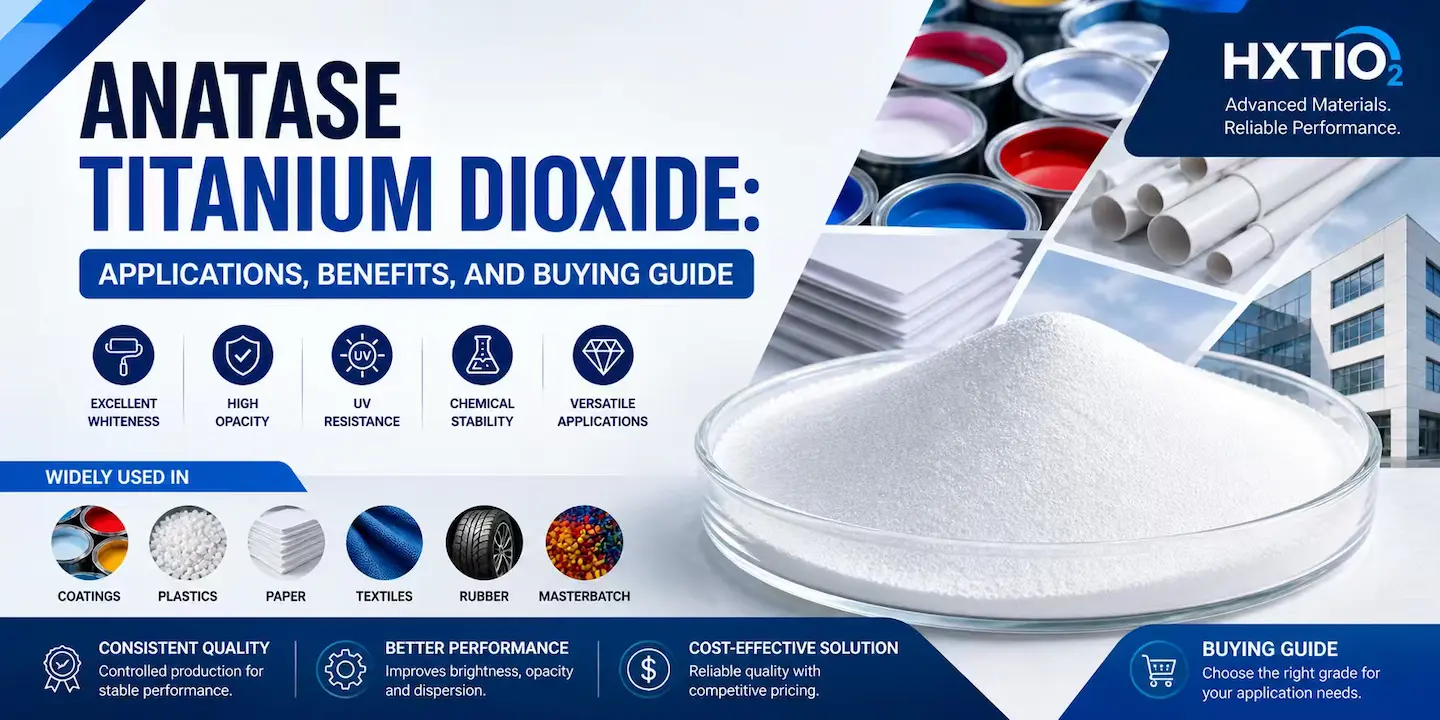
Anatase titanium dioxide is a white pigment used in industrial applications such as coatings, plastics, paper, rubber, and textiles. It offers high whiteness, good dispersion, and stable performance in indoor environments.
In real-world use, anatase TiO₂ improves product brightness and consistency while remaining more cost-effective than rutile titanium dioxide, especially in applications where outdoor durability is not required.
What Is Anatase Titanium Dioxide?
To understand this clearly, think of it as a material used to control both color and consistency in industrial products. Titanium dioxide exists in different crystal forms, and anatase is one of the most commonly used types in indoor applications.
Anatase titanium dioxide is a white pigment that provides brightness and whiteness in products such as coatings, plastics, and paper. It is typically produced using the sulfate process and is known for its fine particle structure and good dispersion.
Instead of reflecting light unevenly, it helps distribute it more uniformly across the surface. At the same time, it blends smoothly into different formulations without affecting processing stability.
So instead of using multiple additives to improve appearance, anatase titanium dioxide works as a single solution that supports both visual quality and production consistency.
Why Anatase TiO₂ Is a Real Solution in Industrial Applications
In many production environments, the goal is not maximum durability but consistent quality at a controlled cost.
Anatase titanium dioxide fits this requirement well.
In real manufacturing conditions:
- It improves whiteness in finished products
- It supports brightness in coatings and paper
- It works well in plastics and rubber applications
- It maintains stable performance in indoor environments
For manufacturers, this means fewer variations in production and more predictable results.
Instead of over-specifying materials, anatase allows you to match performance with actual application needs.
Key Properties of Anatase Titanium Dioxide
-
High Whiteness
Anatase TiO₂ provides a clean and bright white appearance. This is especially important in coatings, paper, and plastic products where visual quality matters.
-
Good Dispersion
It mixes well into different formulations. This ensures that the pigment spreads evenly, avoiding patchy or uneven results.
-
Fine Particle Size
The small particle structure helps create a smoother surface finish and improves the overall look of the final product.
-
Strong Purity
High purity levels help maintain consistency across production batches. This reduces variation and improves quality control.
-
Lower Abrasiveness
Compared to other materials, anatase is less abrasive. This makes it suitable for applications like paper and textiles where surface quality is important.
Where to Use Anatase Titanium Dioxide
Anatase titanium dioxide works best when it is selected based on how a product is actually used. Different industries have different performance requirements, so understanding where this material performs best helps you get real results.
Below are the most common and effective use cases:
Interior Coatings and Paints
Interior coatings require consistent whiteness and brightness. Since these environments are not exposed to harsh conditions, extreme durability is not always necessary.
Anatase titanium dioxide helps by:
- improving whiteness and brightness
- supporting uniform color distribution
- maintaining stable indoor performance
In real use, this creates coatings that look clean and consistent without unnecessary cost.
Plastic Products and Films
Plastic products require stable color and smooth processing. Small variations can affect final appearance.
Anatase titanium dioxide helps by:
- improving color consistency
- supporting even dispersion
- maintaining uniform appearance
This results in plastic products with better visual quality.
Paper Manufacturing
Paper production requires high brightness and low abrasiveness to maintain surface quality.
Anatase titanium dioxide helps by:
- increasing brightness and opacity
- improving print quality
- reducing surface wear
As a result, paper looks cleaner and more refined.
Rubber Products
Rubber applications require consistent appearance and stable formulation.
Anatase titanium dioxide helps by:
- improving whiteness
- maintaining uniform color
- supporting stable performance
This leads to better visual consistency in finished products.
Textiles and Fibers
Textile production requires brightness and uniform color distribution.
Anatase titanium dioxide helps by:
- improving fiber brightness
- ensuring even distribution
- maintaining consistent appearance
Masterbatch Production
Masterbatch requires strong dispersion and consistent particle behavior.
Anatase titanium dioxide helps by:
- improving dispersion
- maintaining batch consistency
- supporting stable processing
In real-world use, this ensures uniform color in final products.
Types of Anatase Titanium Dioxide
Standard Anatase Titanium Dioxide
Standard grades are widely used in general industrial applications.
They typically feature a TiO₂ content ≥ 98%, with controlled particle size and stable whiteness.
Due to their balanced optical properties and low abrasiveness, they provide consistent performance in coatings, plastics, and paper manufacturing.
These grades are the ideal choice for projects where cost-efficiency and reliable quality are primary requirements.
For industries requiring specialized performance—such as electronic-grade purity or specific surface treatments—we recommend consulting our technical team for our Advanced Anatase series
High-Purity Anatase Titanium Dioxide
High-purity grades are designed for applications that require better brightness and cleaner appearance.
They usually offer higher TiO₂ content, finer particle size, and improved dispersion performance.
Because of these properties, they perform better in applications such as high-quality coatings, paper, and textiles.
They help improve final product appearance and reduce variation in production.
These grades are commonly selected when visual quality is a key requirement.
Anatase Titanium Dioxide for Coatings
These grades are optimized for interior coatings and paint applications.
They are designed to provide stable dispersion, good whiteness, and consistent opacity.
Because coatings require uniform finish, these grades help improve surface smoothness and brightness.
They perform well in indoor environments where weather resistance is not the primary concern.
They are widely used in decorative paints and interior wall coatings.
Anatase Titanium Dioxide for Plastics
Plastic-grade anatase TiO₂ is developed for better processing performance.
It typically offers controlled particle size and good compatibility with polymer systems.
Because plastics require stable color distribution, these grades help maintain uniform appearance during processing.
They reduce defects and improve overall product consistency.
These are commonly used in pipes, films, and general plastic products.
Anatase Titanium Dioxide for Paper and Textiles
These grades focus on brightness and low abrasiveness.
They are designed to improve surface quality without damaging processing equipment.
Because paper and textile applications require smooth finish, these grades help enhance brightness and uniformity.
They also support better print quality and visual consistency.
They are widely used in paper manufacturing and fiber applications.
Customized Anatase Titanium Dioxide Solutions
Custom grades are developed based on specific industrial requirements.
These may include adjustments in particle size, purity, or dispersion characteristics.
Because different industries have unique needs, customized solutions help achieve better performance in specialized applications.
They allow manufacturers to optimize both product quality and production efficiency.
However, performance depends on formulation and processing conditions.
| Type | TiO₂ Content | Particle Size | Key Performance | Best Use |
|---|---|---|---|---|
| Standard | ≥ 98% | Medium | High Whiteness, Balanced | General industrial use |
| High-Purity | ≥ 99% | Fine | Premium Brightness | High-end coatings, fibers |
| Coating Grade | ≥ 98% | Optimized | Stable Dispersion, Opacity | Interior wall paints |
| Plastic Grade | ≥ 98.5% | Uniform | Heat Stability, Low Lacing | Masterbatch, thin films |
| Paper/Textile | ≥ 98.5% | Fine | Ultra-low Abrasiveness | Paper, synthetic fibers |
| Custom | Varies by Grade | Adjustable | Application-specific | Specialized use |
What Actually Affects Anatase Titanium Dioxide Performance
Performance is not just about choosing a good product. In real-world use, how well anatase titanium dioxide performs depends on a combination of material quality, formulation, and processing conditions.
Many manufacturers assume that selecting a higher-grade pigment is enough, but results only improve when all these factors work together correctly.
Key Factors That Affect Performance
| Factor | Typical Range | What It Means in Practice |
|---|---|---|
| TiO₂ Content | 98% – 99%+ | Higher content improves whiteness and brightness in final products. |
| Particle Size | 0.2 – 0.3 µm | Smaller particles provide better dispersion and smoother surface finish. |
| Whiteness | ≥ 96% | Higher whiteness leads to cleaner and more consistent appearance. |
| Oil Absorption | 18 – 25 g/100g | Affects formulation balance and processing efficiency. |
| pH Value | 6.0 – 8.0 | Ensures compatibility with different industrial systems. |
| Dispersion Quality | High | Better dispersion improves uniformity and reduces defects. |
Even if you choose high-quality anatase titanium dioxide, performance will still be poor if it is not properly dispersed or matched with the formulation.
For example, using a high-purity grade in a system with poor mixing conditions will result in uneven color and reduced efficiency. The pigment may not distribute evenly, leading to visible inconsistencies in the final product.
In real production environments, the most common mistake is focusing only on material quality while ignoring processing conditions. A well-balanced formulation with proper dispersion will always perform better than a higher-grade product used incorrectly.
In simple terms, anatase titanium dioxide performance is not just about the material—it’s about how the entire system is controlled and applied.
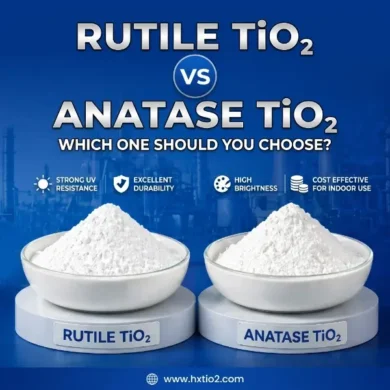
Anatase Titanium Dioxide vs Rutile Titanium Dioxide
At first glance, both anatase and rutile titanium dioxide may look similar. Both are used as white pigments in industrial applications and provide brightness and opacity.
But in real-world use, their performance is completely different.
Anatase titanium dioxide is mainly used for indoor applications. It focuses on whiteness, good dispersion, and cost-effective performance. It works well in controlled environments where high durability is not required.
Rutile titanium dioxide, on the other hand, is designed for higher performance. It offers better weather resistance, stronger opacity, and improved stability under UV exposure.
Key Differences
| Feature | Anatase Titanium Dioxide | Rutile Titanium Dioxide |
|---|---|---|
| Function | Indoor pigment performance | High-performance pigment |
| Weather resistance | Lower | Higher |
| UV stability | Limited | Strong |
| Cost | More economical | Higher |
| Application | Paper, plastics, coatings | Exterior coatings, plastics |
In a controlled indoor environment, anatase titanium dioxide performs effectively because exposure to harsh conditions is limited.
However, in outdoor or high-performance applications, rutile becomes the better choice due to its superior durability and stability.
Instead of using a higher-cost material for every application, selecting between anatase and rutile based on actual requirements helps improve both performance and cost efficiency.
In simple terms, anatase titanium dioxide focuses on cost-effective indoor performance, while rutile titanium dioxide is designed for long-term durability in demanding environments.
Why HENGXIANG Anatase Titanium Dioxide Is a Reliable Choice
When it comes to industrial pigments, the material plays a major role in both performance and production efficiency. This is why anatase titanium dioxide from HXTIO2 is widely used in coatings, plastics, paper, and textile applications.
Anatase titanium dioxide from HENGXIANG CHEMICAL is designed to provide stable optical performance while maintaining good dispersion in different formulations. Its real value comes from how it performs in controlled environments where consistency and cost efficiency are critical.
Why HENGXIANG TiO2 Works So Well
-
Reliable whiteness and brightness
It maintains consistent optical performance, helping improve product appearance across production batches.
-
Good dispersion performance
It blends smoothly into different formulations, reducing uneven color distribution and processing issues.
-
Cost-effective material
Compared to higher-grade alternatives, it provides a balanced solution for large-scale industrial use.
-
Low abrasiveness
It reduces wear during processing, making it suitable for applications like paper and textiles.
-
Consistent performance across applications
It works well in coatings, plastics, rubber, and paper without major variation in results.
In real production environments, anatase titanium dioxide from HXTIO2 provides a balance between performance and efficiency. It delivers stable results without increasing formulation complexity or cost.
At the same time, it allows manufacturers to maintain consistent quality across different applications, making it suitable for both technical and production-focused requirements.
In simple terms, it is not just about cost or appearance — anatase titanium dioxide from HXTiO2 is widely used because it performs reliably where consistent industrial results are required.
Cost vs Performance: What You Actually Get for the Price
The cost of anatase titanium dioxide depends on purity level, particle size, dispersion quality, and application requirements. But in real production, price is not just about the material — it directly affects product quality, processing efficiency, and long-term consistency.
Typical Price Range in Real Projects
| Type | Price Range | Unit | Typical Use Case |
|---|---|---|---|
| Standard anatase grades | $1200 – $1500 | per ton | Utility films & general-purpose injection parts |
| Mid-grade anatase | $1500 – $1800 | per ton | interior project paints, Paper, rubber |
| High-purity anatase | $1800 – $2500+ | per ton | enamel, ceramics, textiles |
| Specialized grades | $2000 – $5000+ | per ton | cosmetics, food addictive, premium applications |
| Bulk supply contracts | $1500 – $2350 | per ton | Large-scale industrial production |
What Affects the Price in Practice
-
TiO₂ purity level
Higher purity (98–99%+) improves whiteness and consistency but increases cost.
-
Particle size distribution
Finer and more uniform particles improve dispersion and surface finish..
-
Dispersion performance
Better dispersion reduces production issues and improves final product quality.
-
Processing quality
More controlled production leads to stable performance across batches.
-
Order volume
Large-scale orders often reduce per-ton cost but require higher initial investment.
Lower-cost options may appear similar, but they often have inconsistent particle size or lower purity, which can affect performance in real applications.
On the other hand, higher-quality anatase titanium dioxide provides more stable results, better dispersion, and improved production efficiency.
In simple terms, you are not just paying for the material — you are paying for consistent performance that directly impacts your final product quality.
What This Means in Real Use
Lower-cost options may look similar, but they often use:
- lower purity material
- inconsistent particle size
- weaker dispersion performance
As a result, they may only slightly improve whiteness and can create inconsistencies in the final product.
On the other hand, higher-quality anatase titanium dioxide:
- delivers consistent brightness and whiteness
- improves dispersion in formulations
- maintains stable performance across production batches
In simple terms, you’re not just paying for raw material — you’re paying for measurable performance that directly improves product quality and production efficiency.
Buying Guide: How to Choose the Right Anatase Titanium Dioxide
Choosing the right anatase titanium dioxide is not just about price — it’s about matching the material with how the final product is actually used.
Here’s a simple step-by-step guide to help you make the right decision:
Define the Application
- For coatings → focus on whiteness, brightness, and dispersion
- For plastics → prioritize particle size and processing stability
- For paper → look for brightness, opacity, and low abrasiveness
Check the Required Purity Level
- General apvsplications → 98% TiO₂ content may be enough
- Premium products → choose 99%+ purity for better consistency
- Avoid low-purity grades if stable whiteness is important
Evaluate Particle Size and Dispersion
- Fine particle size improves surface finish
- Good dispersion reduces uneven color distribution
- Poor dispersion can cause defects in coatings, plastics, and masterbatch
Review Key Technical Data
Check TiO₂ content, whiteness, oil absorption, pH value, moisture, and residue on sieve. These factors directly affect real production performance.
Test Samples Before Bulk Orders
- Request samples before placing large orders
- Test compatibility with your formulation
- Compare brightness, dispersion, and processing results
Compare Price with Performance
- Cheaper grades may reduce initial cost but cause quality problems later
- High-quality anatase titanium dioxide provides better consistency and fewer production issues
Think Long-Term
Stable suppliers provide:
- better quality control
- consistent batch performance
- reliable bulk supply
To explore suitable product options, you can review anatase titanium dioxide solutions from HXTIO2 for industrial applications.
Final Key Takeaways
- Product quality directly depends on pigment consistency
- Anatase titanium dioxide improves whiteness and brightness
- Good dispersion is critical for uniform results
- Purity level affects final product performance
- Particle size impacts surface finish and processing
- Cost and performance should be evaluated together
- Proper selection improves production efficiency and stability
Conclusion
Anatase titanium dioxide is not just a basic white pigment. It is a functional material used to improve product consistency and performance in industrial applications.
By providing stable whiteness and good dispersion, it helps maintain uniform quality across coatings, plastics, paper, and other products. Production becomes more efficient and results become more predictable.
The key is choosing the right grade based on real application needs. When selected correctly, anatase titanium dioxide becomes an essential part of consistent and cost-effective manufacturing.